

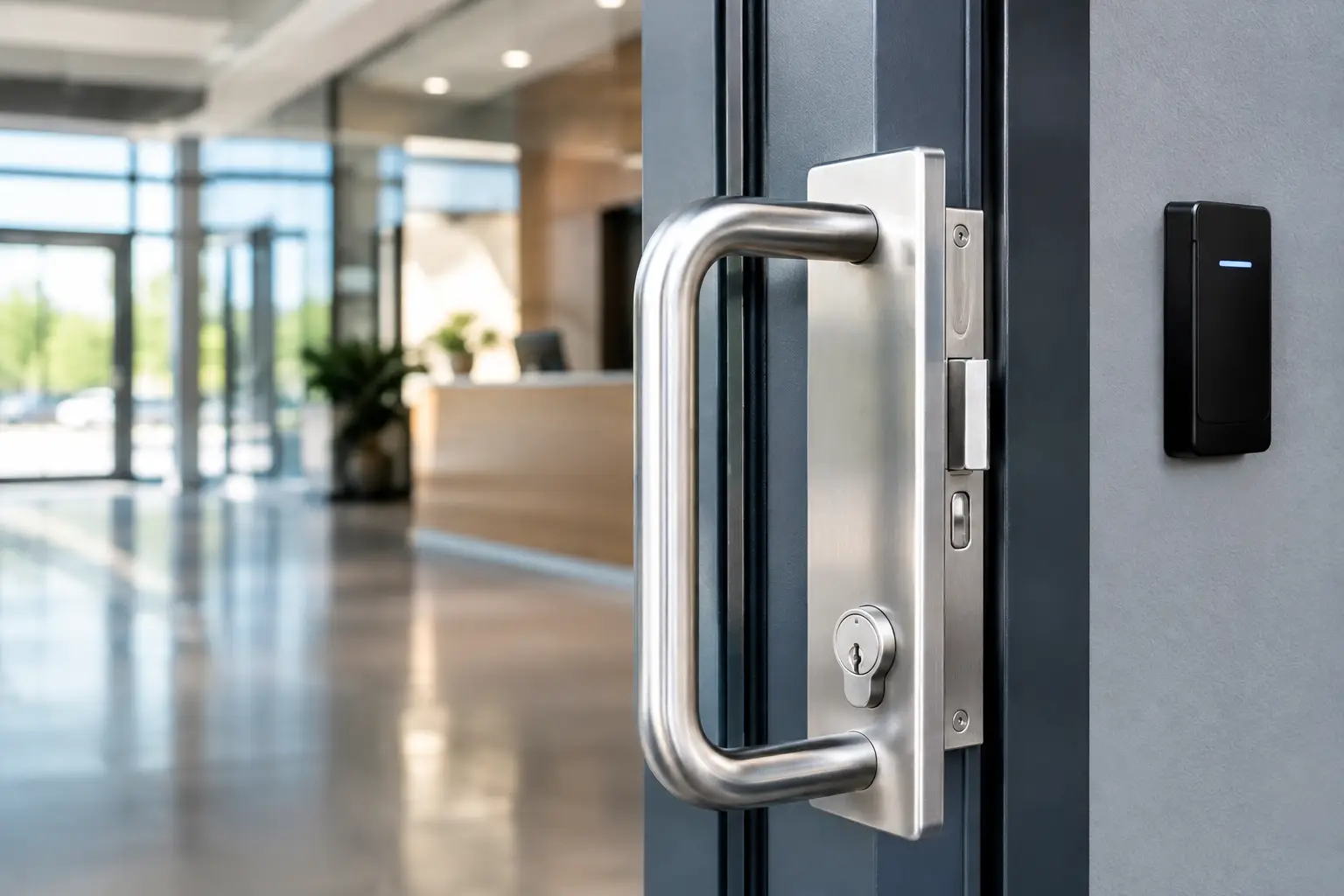
A commercial entrance can look perfectly fine and still create daily problems: a door that slams, a lock that sticks, an exit device that will not latch, or a storefront door that will not close after a busy afternoon. The best commercial door hardware is not simply the strongest option on the shelf. It is the hardware that fits the door, traffic level, security needs, accessibility requirements, and the way your property operates.
For retailers, offices, apartment buildings, restaurants, medical practices, and managed properties across DC, Maryland, and Virginia, the right choice protects people and property while keeping the entrance easy to use. A properly installed closer, lock, hinge, or panic device can prevent callbacks, reduce wear on the door and frame, and help your business stay open without an avoidable repair.
What the Best Commercial Door Hardware Must Do
Commercial door hardware has a harder job than residential hardware. It may handle hundreds of openings per day, resist forced entry attempts, operate in rain and temperature changes, and allow safe egress during an emergency. The hardware also has to work as a system. Replacing one failed part without checking the door, frame, glass, pivots, and strike often solves only part of the problem.
The best option depends on the opening. A glass aluminum storefront door needs hardware designed for narrow stiles and frequent use. A solid metal service door may need a heavy-duty lever lock, continuous hinge, and closer with enough power to control the door. A public exit may require listed panic hardware that releases quickly from the inside.
Security matters, but a tighter lock is not always the answer. If the door is warped, the closer is pulling it out of alignment, or the strike is damaged, even a quality lock can bind. A professional inspection should identify why the hardware failed before replacement parts are selected.
Start with the door and frame condition
Before choosing new hardware, inspect the complete opening. Look for sagging, loose mounting screws, worn pivots, cracked glass stops, bent frames, damaged weatherstripping, and gaps around the door. On aluminum storefront systems, a door may drop slightly over time, causing the latch to miss the strike. On hollow metal doors, repeated slamming can loosen reinforcement inside the door.
Hardware cannot compensate indefinitely for structural movement or a damaged frame. Correcting alignment first gives a new closer, lock, or exit device a fair chance to perform as intended. It also avoids spending money on parts that fail early because the opening was never repaired.
Match hardware to the traffic level
A rear employee entrance used a few times a day does not need the same hardware as a retail front door that opens continuously. Light-duty components cost less up front, but they are usually a poor value on a high-traffic opening. They wear sooner, create security issues, and can leave a business with a door that will not latch at closing time.
For busy entrances, choose commercial-grade closers, pivots or hinges, locksets, and exit devices rated for frequent cycles. Heavy glass doors and oversized doors need special attention because their weight changes the demands on every component. A closer that is too weak may not latch the door. One that is set too aggressively can make the door difficult to open or cause it to slam.
Best Commercial Door Hardware by Door Type
Aluminum storefront doors
Storefront doors are common throughout shopping centers, office buildings, and street-facing businesses. Their narrow aluminum profiles require compatible locks, deadlatches, pivots, and closers. A standard cylindrical lock is often not the right fit for this type of door.
A dependable storefront setup typically includes a commercial deadlatch or hook bolt system, a properly adjusted closer, durable top and bottom pivots, and an aligned strike. For a pair of doors, consider how the active and inactive leaf meet, whether an astragal is needed, and how the doors secure after business hours.
When storefront glass is broken during a break-in, inspect the hardware as well as the glass. Impact can shift the door, damage pivots, bend the frame, or leave the locking system unable to secure properly. Emergency board-up protects the opening temporarily, but the door should be restored to safe operation before the property returns to normal use.
Metal and solid-core commercial doors
Steel, fiberglass, and solid-core wood doors are common at service entrances, stairwells, utility rooms, offices, and rear exits. These doors can accept a wider range of hardware, but compatibility still matters. Fire-rated doors, for example, need listed components that preserve the door assembly’s rating.
A lever lock is often a practical choice where staff or visitors need regular access. For higher-security openings, a mortise lock, deadbolt where permitted, or access-control lock may be more appropriate. The choice should account for who needs access, whether the door must provide free egress, and whether the opening is fire-rated.
Continuous hinges can be a worthwhile upgrade for heavy or high-use doors because they distribute weight along the full edge of the door. They can help reduce sagging, though they will not fix a severely damaged frame or an improperly hung door.
Exit doors and public egress doors
Exit doors require careful planning because life safety comes before convenience. Panic hardware, also called exit hardware, allows occupants to release the door with a push bar or touchpad. It is commonly required on certain assembly, educational, high-occupancy, and hazardous-use openings, but requirements vary by occupancy, occupant load, door location, and local code enforcement.
Do not replace panic hardware with a standard lockset simply because the old device is damaged. That can create a serious safety concern and may violate applicable requirements. The replacement must fit the door, frame, fire rating if applicable, and the building’s egress plan. Local authorities having jurisdiction make final code determinations.
If an exit device is difficult to operate, fails to latch, or has been taped, chained, or blocked to keep a door usable, schedule service quickly. Those are signs that the opening needs attention, not temporary workarounds.
Closers, Locks, Hinges, and Access Control
A door closer is one of the most overlooked parts of a commercial entrance. It controls closing speed, final latch speed, and opening force. Adjustment is not a matter of turning every valve tighter. Improper adjustments can make a door slam, prevent latching, or make access difficult for customers and employees.
Locks should be selected around the level of security the opening needs. A front door may need controlled access after hours but easy access during business hours. A server room, pharmacy area, or equipment room may need restricted key control or electronic credentials. Mechanical hardware is often simpler to maintain, while electronic access control provides better control over who enters and when. Electronic systems also require planning for power, wiring, backup operation, and hardware compatibility.
Hinges and pivots are equally critical. A door that drags across the threshold or scrapes the frame may look like a closer problem, but worn pivots or loose hinges are frequently the cause. Replacing the closer before correcting door movement can lead to another service call soon after.
Do Not Forget Weather Protection and Thresholds
Commercial entry hardware is exposed to the elements. Rain, wind, road salt, and seasonal temperature shifts can wear out weatherstripping, sweeps, thresholds, and door bottoms. In the DMV area, those small gaps can allow water intrusion, drafts, pests, and higher heating or cooling loss.
A threshold and sweep should support the door’s operation, not cause it to drag or bind. On storefront doors, water management around the sill and frame matters just as much as the visible hardware. If the entry has recurring leaks, inspect the complete storefront system rather than replacing weatherstripping alone.
When Repair Makes More Sense Than Replacement
Not every hardware issue requires a new door or a full replacement package. Many problems can be repaired by realigning the door, replacing a pivot, securing loose reinforcement, adjusting a closer, changing a worn latch, or repairing a damaged strike. These repairs can restore safe operation quickly and keep costs reasonable.
Replacement is usually the better choice when hardware is obsolete, repeatedly failing, incompatible with the opening, damaged after forced entry, or unable to meet the property’s security and egress needs. A technician should explain the practical options clearly, including what can be repaired now and what may become a larger issue later.
For urgent problems after a break-in, impact, or shattered storefront glass, the priority is securing the opening immediately. DMV Window Specialist can provide fast commercial glass and door hardware service, including emergency board-up when a property cannot safely remain exposed.
A working entrance should not demand attention every morning or leave your staff struggling with a lock at closing time. Choose hardware based on the full opening, have it installed and adjusted correctly, and address small warning signs before they become an emergency call.
